
The romantic significance and history of the Celtic Love Knot
The love vowel exchanged in the Celtic manner. Learn about the history and meaning of the Celtic Love Knot!
One of the most often used ancient symbols is Celtic Knot work, which has intricate and exquisite designs with profound meaning. Celtic Knot patterns can be seen in jewelry, tattoos, home decor, the Irish countryside, and historical literature.
Celtic knots, which are made of entwined lines that cross in endless patterns, are symbolic of eternity in general. But there are eight different kinds of knots, and each has a distinct significance.
The Trinity knot, Celtic Love knot, Celtic Cross, Spiral Knot, Celtic Shield knot, Dara knot, Solomon’s knot, and the Celtic Sailor’s knot are among the various varieties of Celtic knots.
The fact that Celtic Knots have no beginning or end is among its most amazing characteristics. Additionally, some of these designs have grown in popularity over time while others have not. The Trinity Knot and its importance for faith and love are undoubtedly familiar to you. But there is another version that gained notoriety due to its romantic connotations.
Two hearts that are woven together to form the Celtic love knot represent the love that exists between two individuals. The Celtic people utilized this lovely symbol to commemorate their love. In the same way that couples exchange rings now, they exchange knots.
The Celtic Love Knot’s History
Unbroken loops woven around one another are called Celtic knots. Its lack of beginning and finish is its most notable feature. The motif stands for love between two people, faith, and eternity.
The Late Roman Empire is when knot patterns initially emerged. Interlaced knot patterns spread throughout history to include Islamic, Ethiopian, and Celt cultures. The early Celtic people of Scotland, Wales, and Ireland fashioned these exquisite knots around 2500 BCE. These components represented eternal life to pagans.
Generally speaking, spiral designs would be found in pre-Christian emblems. Celtic designs, on the other hand, are looped, braided, and knotted in post-Christian motifs. Manuscripts were embellished and illustrated with these drawings to depict real-life events. For instance, there are numerous examples of Celtic Knots in the well-known Book of Kells.
The earliest interwoven patterns discovered in Celtic history gave rise to the modern Celtic Love Knot pattern. When we read history books, we discover that pre- and post-Christian periods correspond to the emergence of the earliest interlace patterns.
The meaning of the Celtic Love Knot design
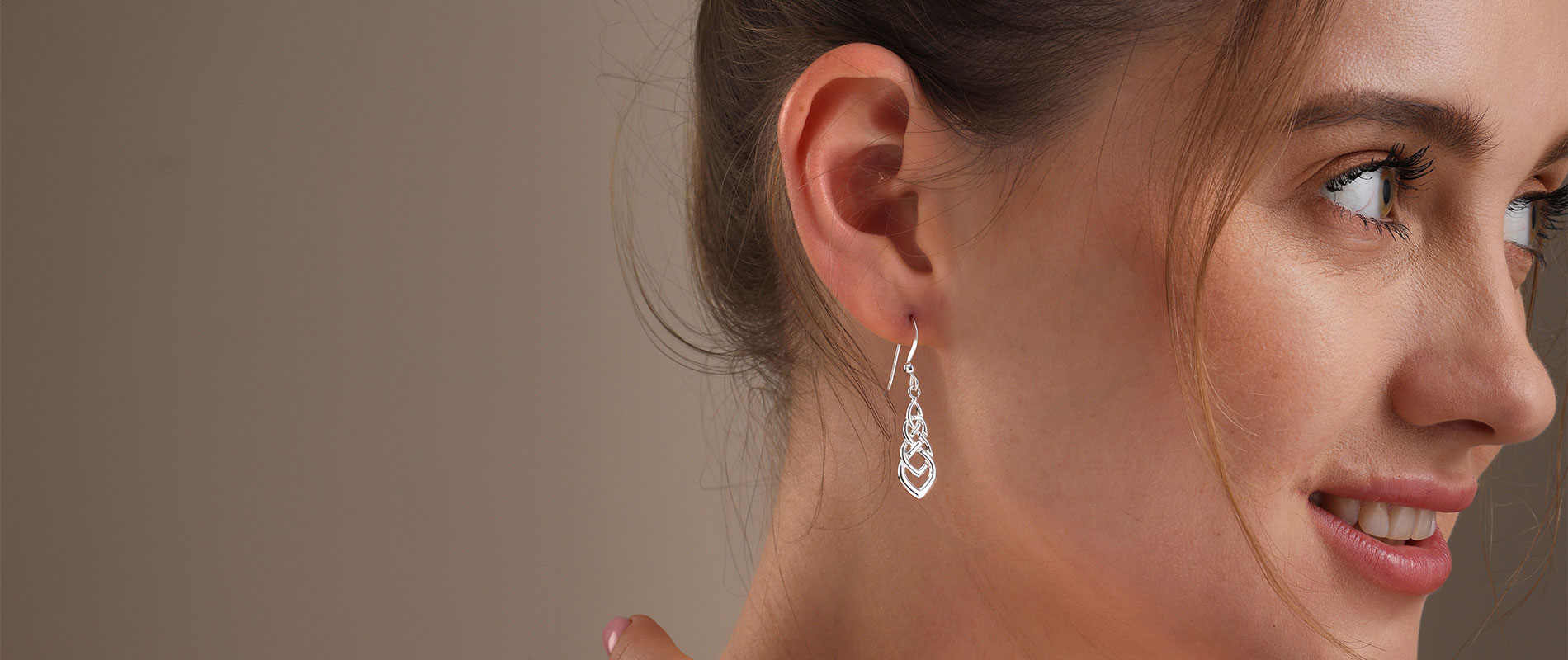
Similar to the classic Celtic knot, the Celtic Love is a contemporary variation that also has infinity motifs. Two Celtic knots are intertwined to form a heart that is displayed in the design. It forms a structure that resembles the intersection of two hearts.
The Celtic Love Knot represents a pair of people’s unending love. This knot, sometimes called the Anam Cara Knot (meaning “soul friend”), has spiritual and religious significance. The Irish language is the source of the word Anam Cara. It is a well-known love phrase that may be found in literature and was even uttered by St. Brigid of Kildare.
Related: The Irish Celtic Cross’s Deep Symbolism and Meaning
Some people think that, similar to how couples share rings now, the Celts traded these knots. As a result, Celtic wedding bands frequently feature these patterns today, signifying the unbreakable tie that unites two people. In addition, it is a symbol of eternal love used in jewelry, tattoos, logos, and embroidery.
In addition to its amorous connotations, it also symbolizes life’s never-ending cycles. It also illustrates what life’s spiritual meaning is. In addition to its universal meaning, the emblem is further enhanced by the shape in which a Celtic Love knot is embedded.
Symbols of the Celtic Love Knot:
Triple Drop Love Knot: It has three lines that stand for fire, water, and earth. The unbroken line stands for existence, spirit, strength, and unification.
One of the earliest types of love knot designs is the Celtic Oval Love Knot, sometimes referred to as the Spiral Love Knot. It stands for unending life.
The triple intertwining lines in the Celtic Round Love Knot stand for the elements of fire, water, and earth. The knot is housed in a circular shape that symbolizes the motion of the sun.
The Celtic Four Love Knot has four circles that weave together. The four seasons of the year are represented by each circle. The twin lines in the margins stand for the love between a pair.
The Celtic Square Love Knot is made out of a single line that circles a square. Because it represents loyalty, it is frequently used into wedding ring designs.
Amazing Facts About Celtic Knots
The primary geometric shapes found in Celtic art include spirals, key patterns, and step patterns. According to academics, early Celtic pagan religions forbade the depiction of humans, animals, or vegetation in artwork. They held that those were the works of their God and that imitation was not appropriate. That may be one of the causes of the geometric shapes seen in most Celtic art.
Pagan designs have a significant influence on Christian Celtic art. But only Christian Knotworks feature the well-known Knotwork that we are familiar with today. In a similar vein, Christians added “forbidden” components to their artwork, like depictions of people, animals, and plants.
The Celtic Love knot is the subject of several legends. The most widely held belief is that if a couple ties a love knot on a tree and it remains there for a year, their relationship will be strong and their love will endure forever.
Related: Discover how to create a beautiful Celtic knot!
In Conclusion
Knot designs have been around for a long time, even though they originated in the Roman Empire. These patterns were an essential component of the pagan cultures that formerly inhabited Ireland, according to Celtic history.
Knots developed into a notable Celtic style that can be found in traditional Irish artifacts, churches, texts, and sculptures. Knots are among the most recognizable Celtic symbols because of this. As an illustration, consider the Triquetra or Trinity Knot.
People have been connecting with their Celtic roots and heritage more and more in recent years. In a similar vein, they started looking for deeper meaning. Consequently, the aforementioned elaborate symbols gained increasing popularity.
The romantic significance of the Celtic Love Knot remains unchanged from the Celts’ time. But as time went on, their use changed, and now they are frequently seen in tattoos and jewelry with Irish symbols.


